

A Year 9 student stays back after class. She waits until the other kids leave, then says quietly: “I just don’t see the point anymore.”
The teacher has done Mental Health First Aid. She recognises this could be serious. She knows the ALGEE action plan. She knows she needs to refer.
But right now, in this moment, she doesn’t know what to say.
That moment — the gap between recognising something is wrong and knowing how to respond — is the reason I get asked this question more than almost any other:
“I’ve already done Mental Health First Aid. Do I really need the Accidental Counsellor Training too?”
Or the reverse: “We’ve booked Accidental Counsellor Training — should we cancel the MHFA course we had planned?”
The short answer: they’re not the same thing. They don’t teach the same skills. And most organisations benefit from both.
One Gives You the Map. The Other Gives You the Words.
Here’s the simplest way I describe it:
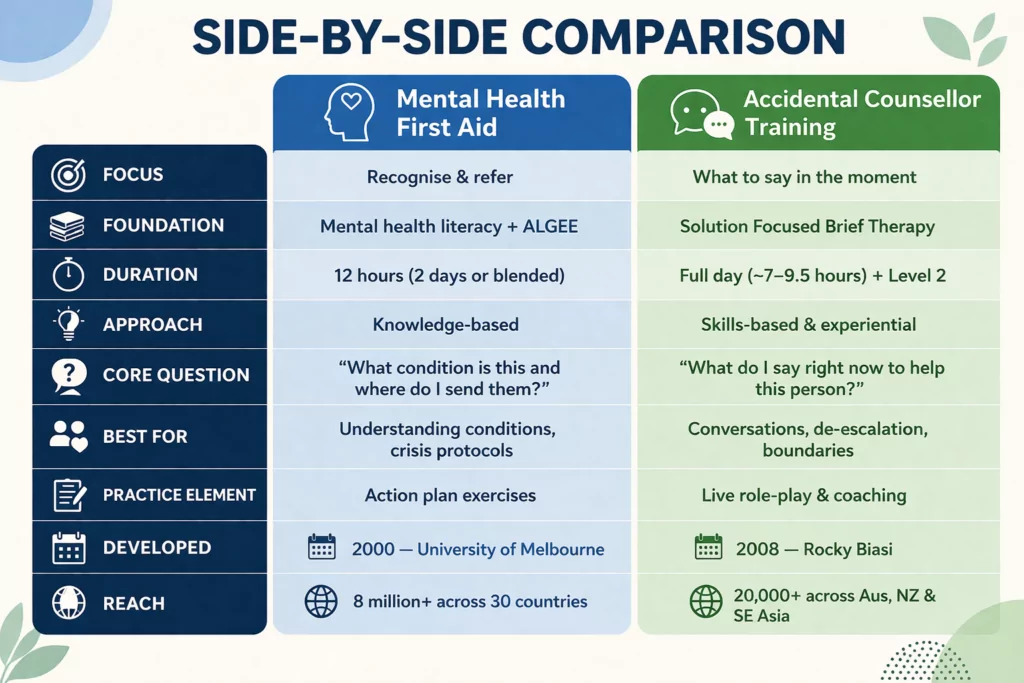
Mental Health First Aid teaches you to recognise a mental health problem and refer the person to professional help.
Accidental Counsellor Training teaches you what to actually say and do when someone opens up to you.
Both matter. But they fill very different gaps — and understanding the difference changes how you plan training for your team.
What Mental Health First Aid Covers
Mental Health First Aid (MHFA) was first developed by Betty Kitchener and Tony Jorm in 2000–2001 at the University of Melbourne. It has since trained over 8 million people across 30+ countries — a respected, evidence-based program for good reason.
The standard course is 12 hours (usually two days or blended) and teaches the ALGEE action plan:
- A — Approach, assess and assist with any crisis
- L — Listen and communicate non-judgementally
- G — Give support and information
- E — Encourage appropriate professional help
- E — Encourage other supports
It covers signs and symptoms of depression, anxiety, psychosis, substance use, suicidal thoughts, panic attacks, and more. Think of it like a physical first aid course: you learn to recognise the injury, stabilise the person, and get them to the right help.
MHFA answers the question: “What’s going on with this person, and where should I direct them?”
What Accidental Counsellor Training Covers
I created the Accidental Counsellor Training in 2008 because I kept seeing the same problem — first as a school counsellor, then working with organisations across Australia, New Zealand and South East Asia.
Teachers, support workers, HR managers, allied health professionals, receptionists — they were all finding themselves in conversations they had never been trained for. A student breaks down after class. A colleague cries in the staff room. A physiotherapist, occupational therapist, or practice nurse whose client wants to talk about something far beyond the appointment they booked.
These people weren’t in a “first aid” situation. They were in a conversation — and they had no idea what to say.
The Accidental Counsellor Training is built around three core themes and is available as a keynote, half-day, or full-day program — all grounded in Solution Focused Brief Therapy:
Wellbeing — Care Without Carrying
Before you support someone else, you need the capacity to stay steady in the conversation — and not take it home with you.
We cover burnout, vicarious load, and practical ways to release the emotional weight after the conversation, so it doesn’t build up over time.
Because if you’re already stretched, you don’t just listen — you absorb.
Connection — The Heart of the Training
Most people think helping is about what to say.
But people rarely remember your exact words — they remember how they felt when they were with you.
Did they feel safe?
Did they feel heard?
We teach both the mechanics (reflective listening, empathy, de-escalation) and the deeper skill of presence — where your attention is fully on them, not on what to say next.
Before we ask a single solution-focused question, we focus on joining the person in the moment — acknowledging, validating, and normalising what they’re feeling.
Influence — Guiding the Conversation Forward
Once someone feels connected and heard, you can start gently guiding the conversation forward.
Not by fixing or giving advice — but by helping them think more clearly.
We use practical tools like scaling and exception questions to help the person recognise their strengths and take a small next step forward.
Accidental Counsellor Training answers the question: “Someone just opened up to me — what do I actually say right now?”
Where the Gap Sits
Go back to that teacher with the Year 9 student.
MHFA taught her to recognise the warning signs and refer. But it didn’t teach her what to say in the next 30 seconds. It didn’t teach her how to sit with that student, stay calm, ask the right questions, and keep the conversation open until help arrives.
It works the other way too. Someone who has done Accidental Counsellor Training knows how to hold a conversation — but might not recognise the early signs of psychosis, or know the difference between a panic attack and an anxiety disorder.
That’s why people who’ve done both say the same thing:
“MHFA gave me the awareness. Accidental Counsellor gave me the confidence — how to actually be in that moment, and what to say.”
Side-by-Side Comparison
So Which One Does Your Team Need?
If your main concern is: “Our staff don’t know enough about mental health conditions and warning signs” → Start with Mental Health First Aid
If your main concern is: “Our staff don’t know what to say when someone opens up to them” → Start with Accidental Counsellor Training
If you can do both: Do both. They complement each other perfectly.
Many schools and organisations I work with have already done MHFA — and they book Accidental Counsellor Training because their staff said: “I know what to look for now, but I still don’t know what to say.”
That’s not a failure of MHFA. It’s just a different skill set.
The First Conversation Changes Everything
After 25 years of training people in this space — over 20,000 teachers, support workers, and frontline staff — here’s what I keep coming back to:
The person who changes someone’s trajectory is rarely the psychiatrist or the crisis line operator. It’s the teacher who stayed back 10 minutes after class. The colleague who said “that sounds really tough.” The support worker who asked one good question.
These people aren’t counsellors. They’re accidental counsellors. And the quality of that first conversation — those first 5 minutes — is often the thing that makes someone feel safe enough to accept help.
MHFA gives you the map. Accidental Counsellor Training gives you the words.
That teacher with the Year 9 student? She doesn’t need to choose between them. She needs both. And so does her team.
Not sure which training is right for your team?
Download the free MHFA vs Accidental Counsellor Comparison Guide — a printable 2-page guide with side-by-side comparisons, a decision framework, and the key questions to ask before you book.