

When Someone Opens Up — Everything Happens in the First Five Minutes
You’re standing at the photocopier when a colleague walks up beside you.
Instead of small talk they say quietly:
“I don’t know how much longer I can do this.”
Or you’re a teacher and a student lingers after class. They’re not asking about homework. They say:
“Things at home are really bad.”
Your heart rate jumps. Your mind starts racing.
What do I say?
What if I make it worse?
In that moment something important is happening.
The first five minutes of that conversation shape everything that follows.
Those first moments determine whether the person feels safe enough to keep talking — or whether they shut down and regret saying anything at all.
After more than 20 years of counselling work and training thousands of people across Australia, New Zealand and South-East Asia, I’ve learned something important:
Those first five minutes are not about having the perfect answer.
They’re about doing a few simple things right.
You’re Already an Accidental Counsellor
Most people think supporting someone in distress is something counsellors do.
But look at your life.
A colleague confides in you.
A staff member breaks down in your office.
A student stays back after class.
A friend calls late at night.
In those moments you become what I call an Accidental Counsellor.
You didn’t train for it. But people still turn to you.
And when they do, the first few minutes of that conversation matter more than you realise.
The Biggest Mistake People Make
When someone opens up, our instinct is to fix the problem.
We jump straight to advice.
- “Maybe you should talk to HR.”
- “You should see a counsellor.”
- “At least things aren’t worse.”
It comes from a good place. We care.
But when someone is in emotional distress their brain isn’t ready for solutions.
It needs safety first.
When we rush to advice, the message they often receive — unintentionally — is:
“Your feelings are uncomfortable, so let’s move past them quickly.”
The most powerful thing you can do in those first minutes is much simpler.
Listen.
The 5-Minute Framework
You don’t need a counselling degree to respond well when someone opens up. You just need to be present. These five steps form the foundation of what we teach in the Accidental Counsellor approach
Step 1: Create Presence (First 30 seconds)
Before you say anything, create a moment of presence. And when I say presence, I mean more than just standing there while someone talks.
Presence means bringing your full attention into the moment with them.
Leaving whatever you were doing…
Putting everything else to the side…
And focusing completely on the person speaking.
Not thinking about what you’re going to say next.
Not analysing the situation.
Not planning how to solve the problem.
Just paying attention.
Listening to what they say, how they say it, their tone, their pace, and the things they might be struggling to put into words.
When someone feels that level of attention, something important happens. Their nervous system begins to settle.
They start to feel safe enough to keep talking. And often that’s the moment the real conversation begins.
2. Listen Without Jumping In (30 seconds – 2 minutes)
Let them talk. Avoid interrupting or preparing your response while they’re speaking. Small signals show you’re listening:
- nodding
- “mm-hmm”
- “I hear you”
Avoid these common traps:
❌ jumping into solutions
❌ turning the story back to yourself
❌ minimising the problem
❌ interrogating them
Your role right now is simply to be with them.
3. Reflect What You Heard (2–3 minutes)
Once they’ve shared, reflect the essence of what you heard. For example:
- “It sounds like you’ve been carrying a lot.”
- “Things at home have been really tough.”
- “You’re feeling stuck and unsure what to do.”
Reflection communicates: “I heard you. I understand.”
If you get it slightly wrong, that’s fine — they’ll correct you, and that actually deepens the conversation.
4. Acknowledge the Courage It Took (3–4 minutes)
Opening up is difficult. Simple acknowledgement helps:
- “Thank you for trusting me with that.”
- “That must have been hard to say.”
- “I’m really glad you told me.”
That moment shifts their internal dialogue from:
“Maybe I shouldn’t have said anything.” to “I’m glad I spoke up.”
5. Ask What Would Help (4–5 minutes)
Only once someone feels heard should you explore next steps. Ask:
- “What would be most helpful right now?”
- “Is there something I can do?”
- “Would you like to keep talking?”
You’re not rescuing them. You’re helping them reconnect with their own next step.
A Short Story That Shows Why This Matters
A teacher once told me about a student who stayed behind after class and said quietly:
“I don’t think I can handle everything right now.”
Her first instinct was to give advice. Instead she paused and said:
“That sounds really heavy. Do you want to tell me more?”
The student talked for fifteen minutes. At the end he said:
“Thanks… I just needed someone to listen.”
Sometimes the most helpful thing you can do is also the simplest.
These Five Minutes Reflect the CLEAR Approach
These steps reflect the first part of the CLEAR Method:
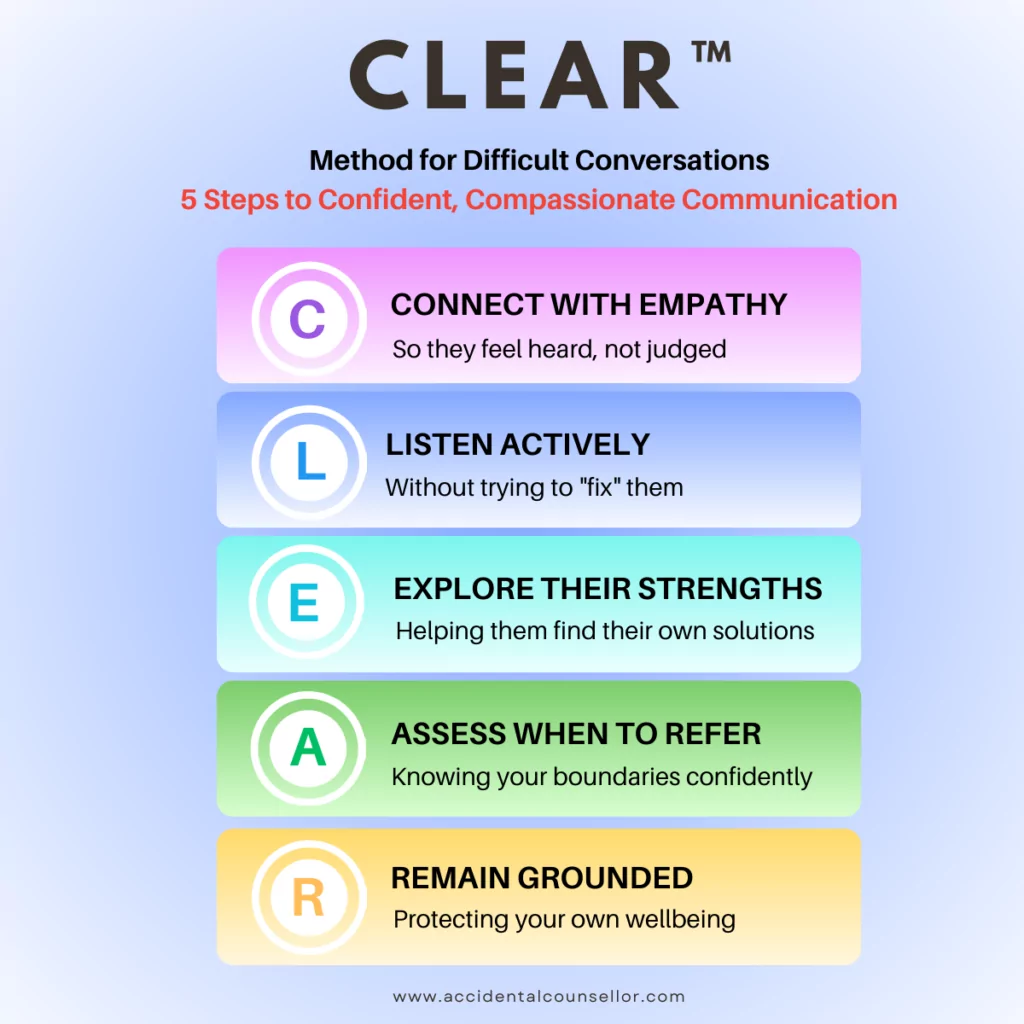
This framework exists because most people who support others are not counsellors.
They’re teachers.
Managers.
Support workers.
Parents.
Friends.
They’re Accidental Counsellors.
The CLEAR Method is at the heart of the Accidental Counsellor Training — a practical, solution-focused program designed for people in exactly these situations.
Sometimes those first five minutes reveal something more than stress or a bad day.
If someone discloses self-harm, suicidal thoughts, abuse, or a safety concern — you don’t need to panic. But you do need to act.
- Stay calm. Your calmness is their anchor.
- Don’t promise confidentiality you can’t keep. Instead say: “I care about you, and if I’m worried about your safety, I might need to involve someone who can help.”
- Know your referral pathways. Every workplace and school should have these. If you’re not sure, find out today — before you need them.
Knowing when to refer is just as important as knowing how to listen.
The Conversation Doesn’t End After Five Minutes
Those first moments create the foundation. But the most powerful thing you can do afterwards is follow up. The next day you might say:
“I’ve been thinking about what you shared yesterday. How are you going today?”
That simple question says something powerful: “You mattered to me then — and you still matter now.”
Download the First Five Minutes Pocket Guide
Because when someone suddenly says: “I don’t know how much longer I can do this…” you won’t have time to Google what to say.
That moment arrives without warning.
I’ve created a free one-page pocket guide that summarises the five steps and helpful phrases you can use.
Download the First Five Minutes Pocket Guide
Keep it at your desk or on your phone.
It’s the kind of thing you’ll be grateful to have when that moment happens.
Because sooner or later, it will.